Monday, March 9, 2009

A Brief Diversion...

Some of my good friends know that for the past couple of years I've been trying to recreate some artifacts from Mormon history. About ten years ago I was at the Daughters of Utah Pioneers museum in Salt Lake City and I saw Brigham Young's bloodstone amulet, mounted in 14k gold. I thought, "Why if that isn't a very expensive rabbit's foot!" The note attached in the display case indicated that it was one of Brigham Young's personal posssions, and that he wore it for protection against evil when going to dangerous places. This bloodstone amulet is also described in more detail in D. Michael Quinn's book, Early Mormonism and the Magic World View.


At any rate, during the past two years I've been trying on and off to recreate this artifact. I spent way too much money on mistakes (once having purchased a rock, paying to have it cut into slabs, only to find out it wasn't bloodstone). I went on rockhounding safaris to far-flung parts of Utah only to find out that the quarry where Brigham Young got his stone was played out and empty. In the end, I found a few small pieces at a rock shop, and cut them to slabs myself on a borrowed saw.

This reproduction isn't quite exact, but its pretty close. And best of all, it is finished and it clips onto my watch chain. Brigham Young wore his on a chain around his neck, next to his skin, hence the hinged pieces I suppose. So then... are you jealous yet? Do you want me to make one for you? How much would you pay? Would silver be as good as gold?

Wednesday, March 4, 2009

It's Tomato Time!

Spring is creeping in here, and tulips are pushing up through the soil. We have so far started 150 little tomatoes, hot peppers, and herb starts. Last year my dear old mother gave me a little grow light, and we rotate the flats through for 8 hours at a time. But I'm getting ahead of myself...

In 1863 seedsman Joseph Ellis Johnson offered more than a hundred varieties of seeds for sale to the Utah market. The same seeds were also sold in Denver as well, so the Utah market was not as isolated as one might think. On his seed list were a couple of varieties of tomatoes: the Fejee and the yellow pear. Johnson's tomato seeds were taken from Fejee and yellow pear tomatoes. They would grow Fejee and yellow pear tomatoes respectively.

Fearing Burr's Field & Garden Vegetables of America (1863) describes the Fejee tomato as follows: "Fruit quite large, red, often blushed or tinged with pinkish-crimson, flattened, sometimes ribbed, often smooth, well filled to the centre; flesh pink, or pale red, firm, and well flavored; plant hardy, healthy, and a strong grower."

We rely on this description because the Fejee tomato is believed to be extinct today. Most commercial tomato production (or most commercial agriculture in general) today relies on hybrid breeding. Where the old heirloom varieties produced plants and fruits which directly resembled the fruit from which the seeds were taken, today's hybrids are a crossing of two varieties. The crossing of these varieties produces seeds which will not reproduce a second time. The advantage for the grower is that the plants yield with greater abundance (known as hybrid vigor), but one crop is all the seed will produce. The same concept is illustrated in cross-bred pigs which grow bigger and faster than pure-bred pigs. Another familiar cross, donkeys with horses, produces mules: big and strong but usually sterile.


For you and me, the practical reality of all this is that as commercial markets move to hybrid varieties, older heirloom varieties go extinct. We no longer have access to many of the vegetables our ancestors ate, so we will never be able to recreate some of their foods. This is especially true of corn, wheat, apples, potatoes, tomatoes-- all the major food crops. Other crops which haven't found large scale commercial production still offer some of the older seeds.

The good news is that there is a growing body of gardeners (excuse the pun) dedicated to saving seeds from their crops, and sharing seeds with other gardeners. Seed Savers Exchange (SSE), a non-profit organization, has helped gardeners connect to preserve older varieties for more than thirty years. With more than a million seed trades on record, we think that some varieties have been saved from extinction. SSE also offers organically-grown seeds of heirloom varieties for sale. You can order online or by telephone. Visit their site for more information.

Last year I grew the two varieties pictured here. The yellow pears were enormously prolific. It blew my mind how many of these little yellow gems we got. They were sweet! We ate them in salad after salad, and in fresh salsa. We got sick of them eventually. They were as prolific as zuchinni or summer squash. We didn't cage them at all, and the runners grew out 10 and 15 feet long, loaded with yellow 'maters.


The Sudduth's Brandywine was also incredible. Matching the Fejee in most respects, it was a delicious if somewhat thick-skinned tomato. They grew to enormous size, many close to two pounds. We didn't cage them either, so the extreme weight of the tomatoes weighed down the vines and we lost quite a few to rot from being on the ground. This year we're caging everything, and can't wait to eat our first fruits. The seeds have all sprouted, and it looks like we should be able to plant them out to the garden in early May.

I hope you all might post back to me with reports of how your heirloom gardens are coming along. I get so excited when I think I'm not alone in my insanity for old fashioned foods and flavors...

Saturday, February 28, 2009

Wild gathered food items: Hops

Recently a new foodie follower asked for more information about wild gathered foods the Mormon pioneers might have used. In my forthcoming book, there is a whole chapter about wild gathered food items, but right now I'm away from home without the full disposal of my research notes. To reward a fellow foodie who asked a specific question I write this:

The early Mormon settlers considered the wilderness around them as just an extension of their gardens. Beginning with the exodus from Nauvoo, they made wild food items a significant part of their diet. The notable example of the miracle of the quail introduced the phenomenon, but even once settled in the Rocky Mountains, wild foods continued to figure significantly in their diet and economy.


Emily Stewart crossed the plains in these early years as a young girl and grew up in the viscinity of Kaysville. As she was growing up, she ate an abundance of pigweed in the early lean years. She also ate sego bulbs, ground cherries, choke cherries and other berries harvested from the foothills and canyons above Kaysville. She noted that her father gathered saleratus from the shores of Great Salt Lake and used it in place of baking soda to raise the biscuits he baked for his family. Wild foods were a substantial part of the Stewart family diet and economy.

As she grew up in such lean circumstances, Emily noted that she never had underwear to wear. But upon her 16th birthday, she decided that if she was ever going to find a husband, she would need some underwear. To this end, she went to the canyon once more that summer to pick hops. This wild herb carries a diverse set of properties utilized by early Mormon settlers for medicinal and culinary uses. Patty Sessions and Eliza Partridge both used hops to make tea when camped at Winter Quarters. Hops are also used in beer brewing as a preservative and bittering agent. Grocers in Salt Lake City paid Emily Stewart $0.50/lb. for her wild hops, and she earned enough to buy several yards of fabric to sew her underclothes. Emily Stewart married John Barnes as his third wife, and her experience is related in her own words in The Grim Years by Claude Teancum Barnes.

Hops still grow wild in many places today. The flower is used fresh. The flower is often about an inch big, looking like many fine feathery leaves piled in a conical shape (see illustration, right side center). Gather the hops while they are still young and green, before they turn dry and papery. You might use a handful of fresh hops in making a pot of tea. You can also buy compressed hop pellets at your local home brewing store, and at some health food stores. In spring time, hops rhiozomes (root starts) can sometimes be bought if you want to try growing this spreading vine at home.

Other wild-gathered food items to explore: wild meats (especially fish in Utah county), berries of all sorts, sego bulbs, salt, saleratus, wild sources of sweetening, and a variety of wild medicinals...

Saturday, February 21, 2009

All about YEAST!


So then, y'all may have seen my recent appearance in the DesNews via "Mormon Times". You can see the whole article here. Basically it was a rehash of the Brigham Young doughnuts I posted a month ago. I was rather flattered with all the new hits that showed up here on the blog. Thanks to all my new friends. I hope you might tell me what sort of historical foodways you'd be interested in reading. I'd be happy to drum up a bit of new research for an appreciative audience.

But back to the doughnuts... they spent a little effort looking into the saleratus issue. Bancroft's History of Utah says that the pioneers used naturally occurring saleratus (like a natural form of soda) gathered near Independence Rock in Wyoming. Bancroft says this was their exclusive leavening for the first five years in Utah. I'm not sure I buy that... why would they suddenly be robbed of a technology they were familiar with before they came to Utah?

At any rate, it got me thinking about the yeast issue again, so here's a short bit of information on yeast. Naturally, the pioneers didn't have Fleishmans' dry active yeast to work with. Individual pioneers kept their own yeast cultures in spite of very inaccurate understanding of microbiology. Pioneer Regina Erickson remembered her mother's stoneware crock where she "used to keep a start of live yeast, set on top of the coal stove warming oven near the back where the temperature was right. I remember licking off the bubbles of yeast as the jar overflowed, and it tasted good.”

The DesNews gives us some specifics about how this culture could be sustained. Naturally, you'd have to have a bit of yeast to begin with, and then this could be multiplied over time, and replenished as it was used. On Nov. 30, 1854, the DesNews published these directions for maintaining a yeast culture:
“To Make Yeast: Hop yeast may be most conveniently made in the following manner: Boil a double handful of hops in a gallon of pure soft water for fifteen or twenty minutes; strain off the liquor while scalding hot; stir in wheat meal or flour till a thick batter is formed; let it stand till it becomes blood warm; add a pint of good lively fresh yeast, and stir it well; then let it stand at a place where it will keep at a temperature of about 70 degrees Fahrenheit, till it becomes perfectly light. This yeast will keep from one to two weeks, if corked tight in a clean earthen jug, and kept in a cool cellar.”


A strikingly similar direction is given in the Deseret Cookbook (1981). Though these early settlers knew next to nothing about microbiology, they still managed to propagate yeast for baking. Some bakers bought their yeast instead of culturing it themselves. Both bakeries and beer breweries in Salt Lake City advertised yeast for sale to home bakers and brewers in the 1850s.

So there ya go... a bit of history about yeast. Someone go give it a try and let us know how it goes!

Monday, February 2, 2009

In the News: Mormon Tea!


On January 20, 2009, Bob Montanez wrote the following in a letter to the editor of the Ogden Standard-Examiner:


"Brigham Young banned the use of caffeine, alcohol and stimulants, but approved drinking "Mormon Tea" as a beverage. This is also used for bronchial and cold medication made from the ephedra plant, stronger than caffeine or any stimulant. Ephedrine is the main ingredient used with precursors, making it 35 times stronger to make methamphetamine or illegal street drugs better known as "meth", "speed", "ice" or "go fast." These are some of the most dangerous illegal drugs in use by addicts today. Ephedrine, known as "whites," can be purchased in truck stops to keep drivers awake. This drug is in full view of children. The ephedra plant grows wild in southern Utah."

His rant was aimed at demonstrating the silliness of the "Zion Curtain" portion of Utah's liquor laws, but that is beside the point. The thing we're concerned with is the validity of this claim that: 1) Brigham Young specifically ordained and advocated the use of the ephedra plant; and 2) wild native ephedra has medicinal properties.

I've been chasing after this elusive goal for quite some time, and I have yet to find any primary source (Brigham Young, or otherwise) identifying tea made from the ephedra plant that grows indigenous to Utah. I have found several other primary sources which show that Brigham Young and many other pioneer settlers drank a sort of tea made from herbs and spices, carrying the name of either "composition tea" or "hot pepper tea." One source called this tea insipid, and another called it the "Mormon Highball." I have found plenty of references to this tea (and also recipes), but not a single reference to the ephedra to which Bob Montanez alludes.

In the LDS Historical Archives in Salt Lake City, there are a couple of extracts from journal articles from the 1970s that call the native ephedra plant "mormon tea" but this appears to be an attribution of the latter half of the twentieth century.

As for Bob's claim that you can get seriously hopped up by drinking ephedra tea-- I imagine there is a great difference between a pharmaceudical grade of ephedra, and tea made from wild plants. Further, my preliminary research shows that although there are some physical commonalities between the appearance of Utah's native ephedra and that of the Chinese medicinal variety, Utah's version has been lab tested to show that it holds no medicinal value. Although the Utah and Chinese plants share the same genus, the medicinal properties are separated in the species and varietals.

If anyone thinks they can cite a primary source for Mormons using native ephedra during Brigham Young's lifetime, I would greatly appreciate the information. But my money is bet on the more likely prospect that it just didn't happen. So next time, I'll tell you all about "Composition Tea." Until then, cast a dubious eye on people like Bob who claim some historical understanding, but fail to cite their primary sources. Why, I could just as easily claim that Brigham Young thought Adam was God! Wait a minute... I think I might have a source on that somewhere... be right back...

Wednesday, January 28, 2009

Here's an easy one... Cambric Tea


Whaddya know, two posts in a week! I gotta slow down or I'll spill all the beans before my book is even published. I was speaking to a guy from the "Mormon Times" page of the DesNews and he wanted to write a piece about Mormon Food, so I told him about Cambric tea. But then in the parting moments of the conversation, I mentioned the previous blog post about Brigham's Doughnuts, and of course that sounded so much more sexy. So I'm writing about Cambric tea here. If any of you find this site because of the Mormon Times link, I hope you'll drop a note and say "hi".


So as I was plugging away at the "beverages" chapter of my book, I stumbled upon a quote from Mrs. Mary Steerforth of Nephi, Utah. Elizabeth Kane had asked her if the early days in Utah were terrible starving times. She replied, "No, not exactly. We always had something to eat, though the poor children used to long for the time when they might eat as hearty a meal as they wanted. We had to reckon so closely how much we could allow for each meal, that we never rose up from one with our hunger satisfied... With a little milk we could make cambric tea, which was found to be one of the best remedies for hunger-- taken hot, and with a little spice or aromatic herbs to flavor it."


Growing up Mormon, I had been trained to think all things "tea" were of the devil, so I had no idea what "cambric tea" might be. Those of you who grew up reading of Laura Ingals and the Little House on the Prairie probably remember her recounting of cambric tea. Cambric of course refers to a delicate white fabric, as in "Tell her to make me a cambric shirt (parsley sage, rosemary and thyme), without a seam or needlework." In most contexts this is a tea made primarily of hot milk and used for childrens' tea parties or for feeble older people whose constitution won't tolerate stronger stuff. Traditional preparation would have a spoonful of sugar in a tea cup, over which was poured a bit of hot water, and the remainder of the cup filled with hot milk. Sometimes a shot of stiffly-brewed black tea is added.


In the case of Mary Steerforth however, the tea was used by adults and children to stave off hunger. As such, milk would have offered more nourishment than tea. In the early days of Utah settlement, sugar was uncommon and expensive; Mrs. Steerforth's sweetener would have been molasses made from beets, parsnips or sorghum cane. Nutmeg, as we learned in the previous post about Brigham's doughnuts, was the common spice of the era. Mrs. Steerforth would have a pierced tin nutmeg grater, and a small stash of whole nutmegs.


So there you are my dears-- a legitimate Mormon tea from the pioneer days. Its delicious, its nutritious, and very refreshing. Try a cup on the next cold night before jumping into bed with your sweetie. Cheers!

Tuesday, January 20, 2009

Brigham's Doughnuts-- regressing a recipe


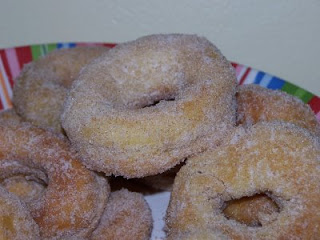
As we learned from the previous post, Brigham Young's diet was not always typical of other early Mormon settlers. For this reason, his daughter Clarissa preferred to eat breakfast with him, since breakfast usually meant doughnuts. Other wives in the Lion House were not so fortunate. Likewise, we might imagine doughnuts were a rare treat in many more common homes. In the Lion House Cook Book we find the recipe for Brigham's buttermilk doughnuts, attributed to Emily Dow Partridge Young. The same recipe is also found in Winifred Jardine's Famous Mormon Recipes:

5 cups flour
2 teaspoons baking soda
1 teaspoon baking powder
1 teaspoon salt
1 teaspoon grated nutmeg
2 cups buttermilk
2 eggs
1 cup sugar
1/4 melted butter
Combine flour, baking soda, baking powder, salt and nutmeg and sift together. Set aside. In large bowl Combine buttermilk, eggs, and sugar. Beat in sifted ingredients until well blended. Stir in butter.Roll or pat dough on floured board about 1/4 inch thick and cut with 2 1/2 inch doughnut cutter. Fry in hot fat until golden brown on both sides. Drain and sprinkle with powdered sugar.

The recipe carries several hallmarks of the settlement era: nutmeg was the common go-to spice for all occasions, much as the modern chef might use cinnamon today. Also, the use of soda and buttermilk suits the period. When chemical leavening was called for, it was soda or saleratus, activated with an acid agent, such as buttermilk. On the other hand, baking powder would not likely have been used in Brigham's era. Although baking powder (soda pre-mixed with tartaric acid and corn starch as a drying agent) was invented England in 1843, it was not widely produced or sold in America until the late 19th century. Further, with buttermilk and soda already in the recipe, the inclusion of baking powder is redundant. Jardine admits in a note to the recipe that it has been "modernized". We doubt that the modernization made this doughnut any more enjoyable.

To this end, we present for your gastronomical pleasure two doughnut recipes from original cookbooks of the era:

1 pint of flour,
1/2 a pint of sugar,
3 eggs,
1 oz. of butter,
1 cup of buttermilk,
1 large teaspoon of saleratus.

Beat the eggs and sugar well together, warm the buttermilk, stir while warming, to prevent a separation, rub down fine the saleratus, and stir into the buttermilk; mix whilst in a foam. If lard is used, use salt. [From The Housekeeper's Assistant, Boston 1845. The original text does not specify a cooking method, e.g. frying in lard.]

And here's another: "Three cups of sugar, three eggs, one cup of butter, one pint of buttermilk, one cup of cream, one nutmeg, saleratus sufficient for the buttermilk; mould with flour." [From The New England Economical Housekeeper, Cincinatti 1845. Again, no cooking method specified.]

We need not debate whether Brigham Young ate doughnuts, or whether doughnuts were a common food item during the Mormon settlement era. Instead, we might find a more interesting discussion about the technology represented in leavening from soda and buttermilk, or the even more pressing question as to why Winifred Jardine would feel compelled to "modernize" a classic recipe that would serve as a vital document of history. Please, share your thoughts!